Commercial epoxy flooring gives Orlando businesses a single seamless surface that is tough under heavy traffic, easy to sanitize, chemical-resistant, and slip-safe — which is why it shows up in everything from warehouses to restaurant kitchens to medical suites across Central Florida. The key in this market is building the system for both the use case and the climate: moisture mitigation for humid slabs and a UV-stable topcoat for sun exposure.
This guide walks business owners through why epoxy beats tile and bare concrete for commercial use, how the system changes by industry, the coating systems we install, the Orlando-specific factors that affect every commercial job, and what to expect on cost and downtime. If you want a tailored recommendation for your facility, call (407) 783-8654 for a free walkthrough.
Why Orlando Businesses Choose Epoxy
A commercial floor has to earn its keep. Epoxy does that on several fronts at once, which is why it has become the default for serious commercial spaces.
- Durability: a properly built epoxy system stands up to forklifts, pallet jacks, rolling stock, and constant foot traffic without cracking or wearing through.
- Seamless and sanitary: with no grout lines or seams to trap dirt and bacteria, epoxy is far easier to clean and sanitize than tile — critical for kitchens and medical spaces.
- Chemical resistance: the right system shrugs off oils, solvents, cleaning chemicals, and food acids that would stain or etch bare concrete.
- Slip resistance: an aggregate or quartz broadcast brings traction up to a safe level for wet commercial areas.
- Lower lifetime cost: easy maintenance and a long service life mean a lower total cost of ownership than repeatedly patching concrete or replacing tile.
For a busy Orlando operation, the seamless, wipe-clean surface alone often justifies the investment by cutting cleaning time and downtime.
It also helps to understand what epoxy is replacing. Bare concrete looks economical until you account for the dusting, staining, and surface cracking that come with daily commercial use — and the dust and trapped grime become a real problem in food-prep and clinical settings. Tile carries grout lines that crack, stain, and harbor bacteria, and a single broken tile in a high-traffic aisle is both a trip hazard and a recurring repair. A poured epoxy system removes those seams and gives you one continuous, sealed surface that is engineered to outlast both. For an Orlando business owner weighing the options, the question is rarely whether epoxy outperforms tile or concrete — it is which epoxy system fits the space and the budget.
Epoxy by Industry
The right system depends on what the floor has to survive. Here is how we approach the main commercial categories in Orlando.
Warehouses & distribution
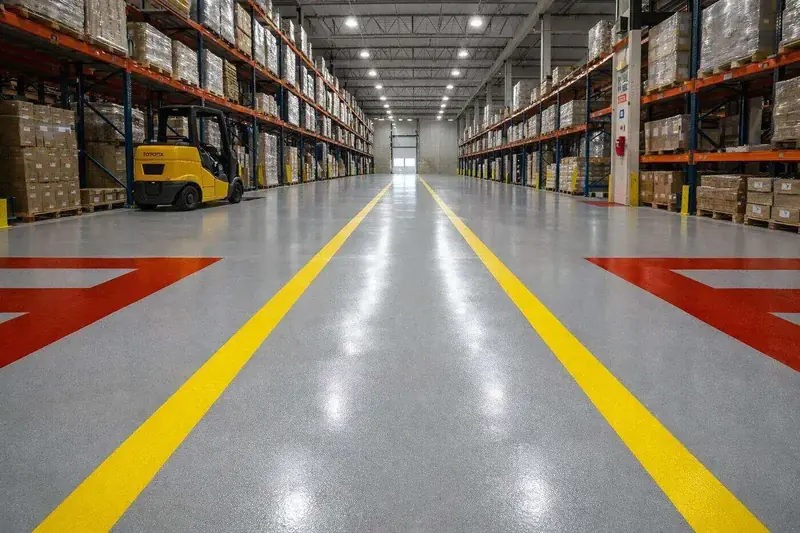
High-traffic warehouse floors take forklift wheels, dropped loads, and constant movement. We build thicker-mil systems with durable topcoats and clear traffic-lane markings where needed, engineered to handle Orlando's logistics and storage facilities without chipping or dusting.
Restaurants & commercial kitchens
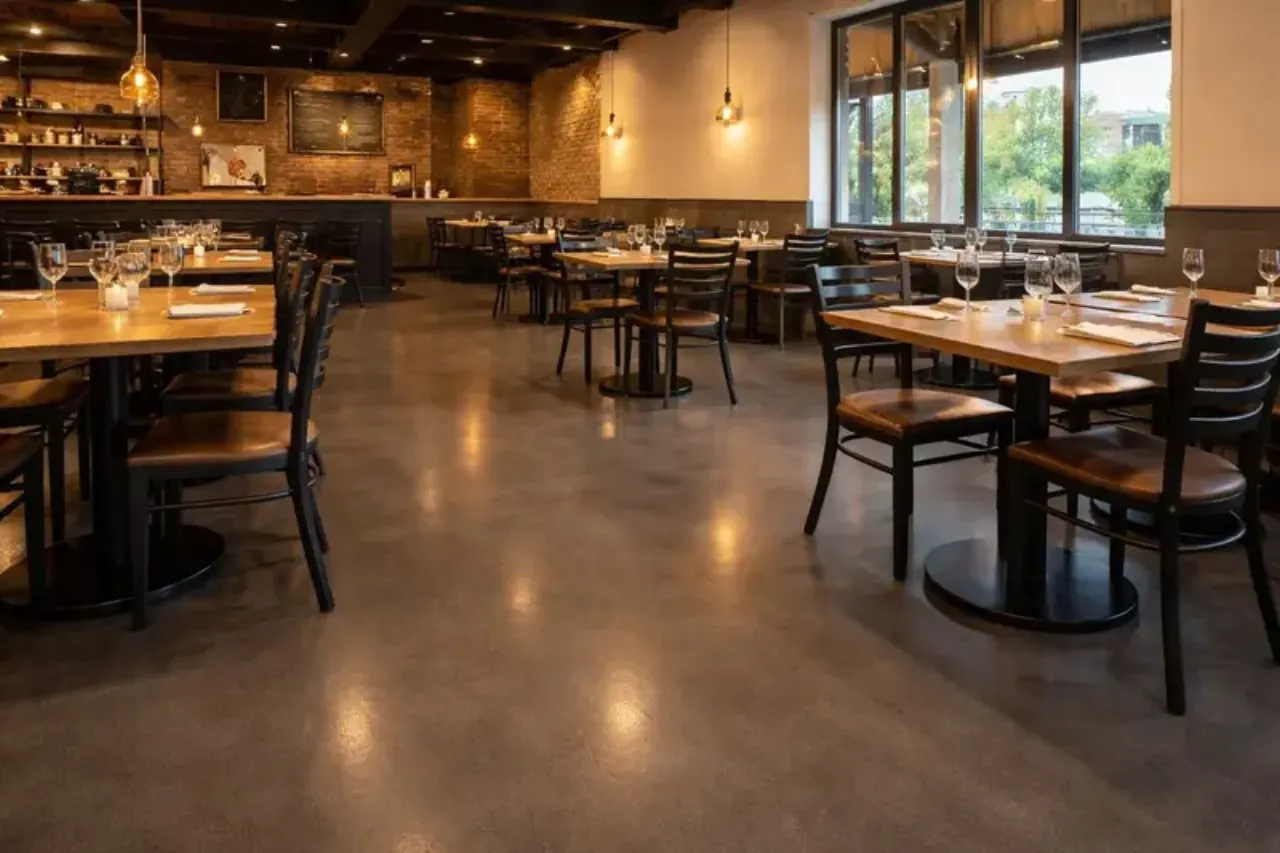
Kitchens demand a sanitary, slip-resistant, chemical-resistant floor that meets health-code expectations. A quartz broadcast system with integral cove base creates a seamless, cleanable surface that handles grease, hot water, and constant wash-downs — the standard for Orlando restaurants and food-service spaces.
Retail & hospitality
Here the floor is part of the brand. Decorative flake and metallic systems give Orlando retail shops, showrooms, and hospitality venues a polished, distinctive look that still wipes clean and stands up to customer traffic.
Auto shops & dealerships
Auto floors face hot tires, oil, brake fluid, and heavy equipment. A chemical-resistant epoxy with a tough polyaspartic topcoat resists staining and hot-tire pickup while giving a service bay or showroom a clean, professional finish.
Medical & healthcare
Clinics, labs, and healthcare facilities need a seamless, sanitary, chemical-resistant floor that supports infection control. Quartz and high-performance epoxy systems with cove bases provide an easy-to-disinfect surface with no seams for contaminants to hide in.
Commercial Coating Systems
The table below maps common commercial systems to where they fit and roughly what they cost in the Orlando market.
| System | Best for | Key strength | Cost / sq ft |
|---|---|---|---|
| Solid-color epoxy | Warehouses, utility areas | Durable, economical | $5–$8 |
| Decorative flake | Retail, showrooms | Looks + slip resistance | $6–$10 |
| Quartz broadcast | Kitchens, medical | Sanitary, anti-slip | $7–$13 |
| Metallic epoxy | Hospitality, brand spaces | Premium appearance | $8–$15 |
| Polyaspartic topcoat | Sun-exposed / fast turnaround | UV-stable, fast cure | +$1–$3 |
These systems are not mutually exclusive. A real commercial floor is usually a stack: a primer or moisture-mitigation base, the body coat that gives the floor its character and build, an optional aggregate or flake broadcast for traction, and a topcoat that seals everything and handles the wear. The polyaspartic line in the table is a topcoat add-on rather than a standalone floor, which is why it is priced as a per-square-foot upgrade. In practice we mix and match: a quartz body coat under a polyaspartic topcoat for a sun-exposed kitchen, or a solid-color epoxy with a high-traffic urethane topcoat for an interior warehouse aisle. The right combination is what gets specced after we see the slab and understand how the space is used, so treat these numbers as planning ranges rather than a firm quote.
Explore finishes and get an Orlando price range in 60 seconds.
Open Floor Studio →The Orlando Factor
Two Central Florida realities shape every commercial epoxy job here, and ignoring either is the fast track to a failed floor.
Moisture mitigation
Orlando's humidity and high water table push moisture vapor up through commercial slabs. More than half of the commercial projects we see require moisture testing and, where readings are high, a vapor barrier before coating. On a large warehouse or kitchen slab this is essential — skip it and the coating can blister and delaminate across thousands of square feet. We test every commercial slab as standard practice.
UV and heat
Loading docks, entryways, showroom windows, and any sun-exposed bay take real UV in Central Florida. A UV-stable polyaspartic topcoat keeps those areas from yellowing and chalking, and its heat resistance helps in spaces where doors stay open to the Florida sun. For more on why this matters, see our guide to Orlando humidity and epoxy.
Need a commercial floor that performs?
We will walk your facility, test the slab, and spec a system for your industry and budget — phased to keep you running.
Cost & Minimizing Downtime
Commercial epoxy in Orlando generally runs $7 to $15 per square foot, with large warehouse and industrial floors often landing in the $4 to $10 range thanks to economies of scale. The biggest cost drivers are slab condition and prep, moisture mitigation, the coating system and topcoat, anti-slip and chemical-resistance requirements, and whether the work must be phased around your operations. For full line-item context, see our 2026 Orlando cost guide.
It helps to know which of those drivers actually move the number. Slab prep is the one most people underestimate: an old Orlando warehouse floor with oil saturation, prior coatings, or surface cracking needs more grinding, patching, and sometimes shot-blasting before anything goes down, and that labor is real. Moisture mitigation is the next big one — if testing flags a high vapor reading, a mitigation primer adds cost across the whole footprint, but skipping it is how a cheap floor fails. The coating system itself sets the middle of the range, and the finish requirements push it: a USDA-style quartz kitchen floor with cove base costs more per foot than a plain warehouse slab, and heavy chemical or anti-slip specs add up. Square footage works in your favor, which is why a 20,000-square-foot warehouse prices lower per foot than a 1,500-square-foot shop even though the total invoice is larger.
Keeping the doors open
For most businesses, the real cost of a floor is lost operating time, so we plan to minimize it. Work can be phased section by section, scheduled for nights and weekends, and finished with fast-curing polyaspartic to shorten return-to-service. We map the sequence around your workflow and give you a realistic timeline before we start, so there are no surprises.
A few details make a big difference for an Orlando business. A restaurant or retail space can often have its floor done in zones over a slow week so the operation never fully closes; a warehouse can be coated aisle by aisle while inventory shifts to the finished side. Where a fast turnaround is critical, a polyaspartic build can put a floor back in light service the same day or next morning rather than after the multi-day cure a thick all-epoxy stack needs. The point of the walkthrough is to lock those logistics in advance — what gets coated when, when foot traffic resumes, and when forklifts or racking can come back — so you can plan around it instead of guessing.
Frequently Asked Questions
Why do Orlando businesses choose epoxy flooring?
Commercial epoxy gives Orlando businesses a seamless, non-porous floor that is durable under heavy traffic, easy to sanitize, chemical-resistant, and slip-resistant when finished with the right aggregate. It handles forklifts, foot traffic, spills, and wash-downs without the grout lines, cracks, or staining of tile and bare concrete, which lowers long-term maintenance cost.
What types of businesses use commercial epoxy floors?
In the Orlando market, warehouses and distribution centers, restaurants and commercial kitchens, retail and hospitality spaces, auto shops and dealerships, and medical and healthcare facilities all use epoxy. The system is tuned to each: heavy-duty builds for warehouses, USDA-compliant quartz for kitchens, decorative finishes for retail, and chemical-resistant coatings for auto and medical.
How much does commercial epoxy flooring cost in Orlando?
Commercial epoxy in Orlando generally runs about $7 to $15 per square foot, with large warehouse and industrial floors often landing in the $4 to $10 range due to economies of scale. Final cost depends on the system, slab condition, moisture mitigation, anti-slip and chemical-resistance requirements, and whether the work must be phased around operations.
Does Orlando's climate affect commercial epoxy floors?
Yes. Central Florida humidity and a high water table mean commercial slabs frequently need moisture testing and a vapor barrier before coating, and sun-exposed areas need a UV-stable polyaspartic topcoat to avoid yellowing. More than half of Orlando commercial projects require some form of moisture mitigation, so it is a routine line item here rather than an exception.
How long does a commercial epoxy floor last?
With proper installation, commercial epoxy floors typically last 5 to 15 years depending on traffic and use: restaurant kitchens around 5 to 10 years, auto and showroom floors 8 to 12, and light-industrial warehouses 10 to 15. Thicker mil builds, the right topcoat, and good slab prep push a floor toward the higher end of its range.
Can epoxy be installed without shutting down my business?
Often, yes. Work can be phased section by section, scheduled for off-hours or weekends, and finished with fast-curing polyaspartic to shorten downtime. We plan the sequence around your operations so the business keeps running wherever possible, and we give you a realistic return-to-service timeline up front.
Get a Commercial Floor Built for Your Business
The right commercial epoxy floor is the one engineered for your industry and for Orlando's climate — moisture-mitigated, slip-rated where it counts, and topped to survive the sun. We will assess your facility and recommend the system that fits, then install it with minimal disruption.
Ready to talk? Call us at (407) 783-8654 or request a free quote online. We serve Orlando, Kissimmee, Winter Park, Sanford, Apopka, Altamonte Springs, and businesses throughout Central Florida.