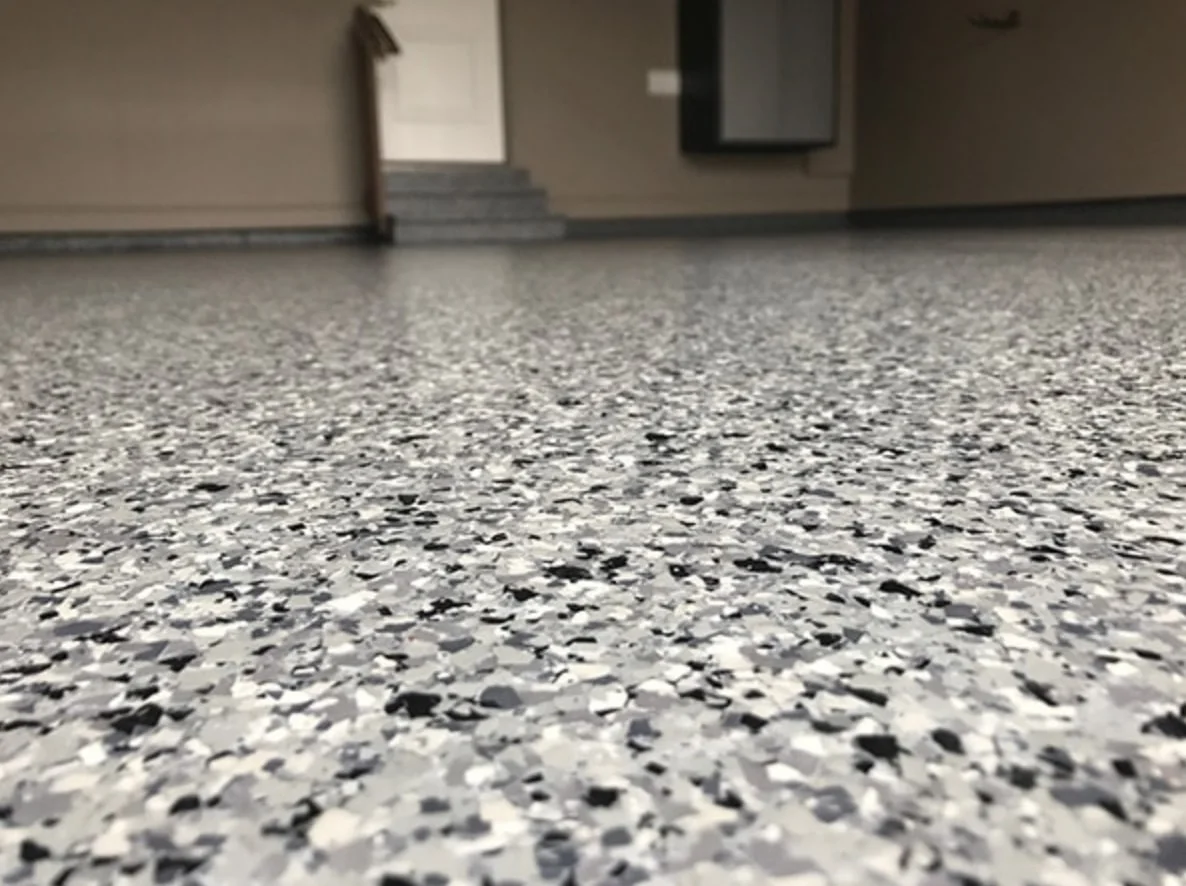
Standard epoxy floors are glossy by design — that's part of the appeal. But that same gloss is the reason this question is the most-Googled epoxy safety query in the Orlando metro: is epoxy flooring slippery? The honest answer: a smooth epoxy floor with no aggregate added is slippery when wet. The good news: any reputable Orlando installer can dial in slip resistance to whatever level you need, from light kitchen-friendly texture all the way to OSHA-rated industrial broadcast.
This guide covers the slip-resistance options Orlando homeowners and businesses should know about, why Florida's humidity makes this question more practical here than in drier climates, and what to ask any epoxy installer before signing a contract.
Why epoxy can be slippery
A cured epoxy topcoat is essentially a hard, glassy resin. Smooth and shiny are part of the look — they make light pop and metallic and flake finishes look incredible. But the same surface that reflects light reflects water, and once a thin film of water sits on top, the coefficient of friction drops fast. The ANSI A326.3 wet-DCOF (Dynamic Coefficient of Friction) threshold for safe wet flooring is 0.42; an unmodified epoxy topcoat in Orlando typically tests around 0.25–0.35 wet — below the threshold.
This is exactly why the question matters more in Central Florida than almost anywhere else in the country. Orlando is a wet-floor market: afternoon thunderstorms most summer days, high ambient humidity that condenses on a cool slab, washed cars dripping in the garage, pool water tracked across a lanai, and bare feet everywhere a pool is involved. A floor that is perfectly safe dry but slick wet is a real hazard here in a way it simply is not in a dry climate. The good news is that slip resistance is a design choice made at install time, not a fixed property of epoxy — and a competent installer dials it in to match how wet your specific space gets.
Slip-resistance options
There are four standard ways to add slip resistance: (1) Decorative flake broadcast — vinyl chips broadcast into wet epoxy create texture as a side effect of the look. Most residential garage installs include flake by default. (2) Aluminum oxide aggregate — a fine grit broadcast into the topcoat. Invisible from a distance, you feel it underfoot. Standard for kitchens, laundry rooms, and pool patios. (3) Silica sand — coarser grit, used commercial. (4) Polymeric beads — clear beads that preserve the look of the topcoat while adding bite. Best for high-end metallic floors where appearance matters most.
The trade-off across these four is grip versus cleanability versus appearance. A heavy silica broadcast gives you maximum traction but holds more dirt and needs a stiff brush to deep-clean; a fine polymeric bead is nearly invisible and easy to mop but adds the least bite. Aluminum oxide sits in the practical middle for most residential wet areas, and a standard flake broadcast gives "free" traction because the texture is a byproduct of a look most Orlando homeowners want anyway. The art is matching the aggressiveness of the texture to the actual risk in the room — there is no single right answer for a whole house.
What we recommend for Orlando spaces
For Orlando garages, flake broadcast at standard density gives plenty of grip and looks great. For lanais, pool decks, and pool-adjacent spaces, we use aluminum oxide aggregate at medium density — it lifts the wet DCOF above 0.50. For commercial kitchens (USDA / FL DBPR), we spec silica sand or aluminum oxide at high density for OSHA-rated wet traction. Restaurants near International Drive, Lake Nona healthcare back-of-house, and Disney vendor kitchens we’ve done all use this spec.
Slip-resistance by space — what we spec and why
Because the right texture is space-specific, it helps to see the recommendations laid out side by side. The table below is the starting spec we bring to an Orlando estimate; we adjust it after seeing how a particular room is used.
| Space | Recommended anti-slip | Why this level |
|---|---|---|
| Home garage | Full vinyl flake, standard density | Texture comes with the look; handles tracked-in rain and a washed car |
| Lanai / pool deck | Aluminum oxide, medium density | Standing water plus bare feet — lifts wet DCOF above the safe threshold |
| Kitchen / laundry | Fine aluminum oxide | Occasional spills; grip without a texture that traps food or lint |
| Showpiece metallic floor | Clear polymeric beads | Adds bite while preserving the mirror-like metallic appearance |
| Commercial kitchen (DBPR) | Silica sand or high-density aluminum oxide | OSHA-rated wet traction for grease, water, and constant foot traffic |
Does the texture make cleaning harder?
This is the most common follow-up question, and the honest answer is: only a little, and only at the aggressive end. A standard flake or fine aluminum-oxide finish stays easy to maintain with the same dust-mop and damp-mop routine as a smooth floor, because the texture is shallow — dirt sits on top and lifts off. The heavier silica broadcasts used in commercial wet areas do hold more grime in the profile and benefit from a stiff-bristle deck brush during a deep clean. For a home, you will almost never need that level of aggression, so the cleaning penalty is negligible. We would rather a family with a pool have a slightly more textured lanai that is safe than a glassy one that looks perfect and sends someone to the ER.
What to ask your installer
Three questions: (1) Will my floor have flake, aggregate, or smooth topcoat? (2) What is the wet DCOF rating of the system you’re installing? (3) Can you provide an ANSI A326.3 spec sheet for the topcoat? If they can’t answer all three, get a second quote.
A fourth question worth adding in this market: is the topcoat a UV-stable polyaspartic? In Orlando, traction and sun-resistance are linked decisions, because the spaces that get wettest — lanais, pool decks, open-door garages — are also the spaces that get the most direct UV. A smooth epoxy that yellows under the sun and a slick floor are two symptoms of the same shortcut, so an installer who specs the right polyaspartic for sun is usually the same one who specs the right aggregate for grip. If you want to see how these material choices play into overall budget, our Orlando cost guide breaks down the topcoat and aggregate line items.
Frequently Asked Questions
Is epoxy flooring slippery when wet?
A smooth, glossy epoxy floor with no additives can be slippery when wet, the same as polished concrete or tile. But epoxy is fully customizable for traction. By broadcasting an anti-slip aggregate or vinyl flake into the coating, an Orlando installer can bring a floor up to a safe slip-resistance rating for garages, lanais, pool decks, and commercial wet areas.
How do you make an epoxy floor non-slip in Orlando?
There are three common methods: a full broadcast of vinyl color flake, which adds texture and is standard on Orlando garages; an aluminum-oxide or polymer-grit additive mixed into the topcoat for a fine, sandpaper-like grip; and a quartz aggregate broadcast for heavy-duty commercial traction. The right choice depends on how wet the space gets and how the floor will be used.
Is flake epoxy slip-resistant enough for a Florida garage?
Yes. A full flake broadcast creates a subtly textured surface that provides good traction even when the floor is wet from rain tracked in off the driveway or a washed car. For most Orlando garages, a full-flake system with a polyaspartic topcoat delivers the right balance of grip, looks, and easy cleaning without feeling rough underfoot.
What slip-resistance do Orlando pool decks and lanais need?
Pool decks, lanais, and other areas that stay wet should use a heavier aggregate or quartz broadcast for maximum traction, since these spaces combine standing water, bare feet, and Central Florida's frequent summer storms. We recommend a higher-grip texture for any space where slipping carries real injury risk.
Does adding anti-slip texture make the floor hard to clean?
A standard flake or fine-grit finish stays easy to clean with a dust-mop and damp-mop, because the texture is shallow. Very aggressive aggregate finishes used in commercial wet areas hold a little more dirt and may need a stiff-bristle brush, which is a fair trade-off for the extra safety those spaces require.
What should I ask an installer about slip resistance?
Ask which anti-slip system they recommend for your specific space and why, whether the texture is matched to how wet the area gets, and whether the topcoat is UV-stable polyaspartic for Orlando sun exposure. A good installer tailors the traction level to the room rather than applying one finish everywhere.
Get a free Orlando quote
Quote within 24 business hours. ASTM moisture testing on every slab. Written warranty.
Get a Free Quote Call (407) 783-8654Planning a budget? See our 2026 Orlando epoxy flooring cost guide for line-item pricing by project type.