If you’re researching epoxy flooring for an Orange County, Florida home or business, this is the consolidated answer to the most common questions: what types of epoxy exist, what they cost in 2026, how long installation takes, what to expect from Florida’s climate, and how to tell a real installer from a franchise stock-photo shop.
We’ve been installing epoxy across Orange County, Seminole, Osceola, Lake, and the Polk vacation-rental corridor since 2019 — BBB A+ Accredited, 4.9★ across the Ascent Epoxy network, 200+ five-star reviews. This guide consolidates what we’ve learned.
Types of epoxy systems
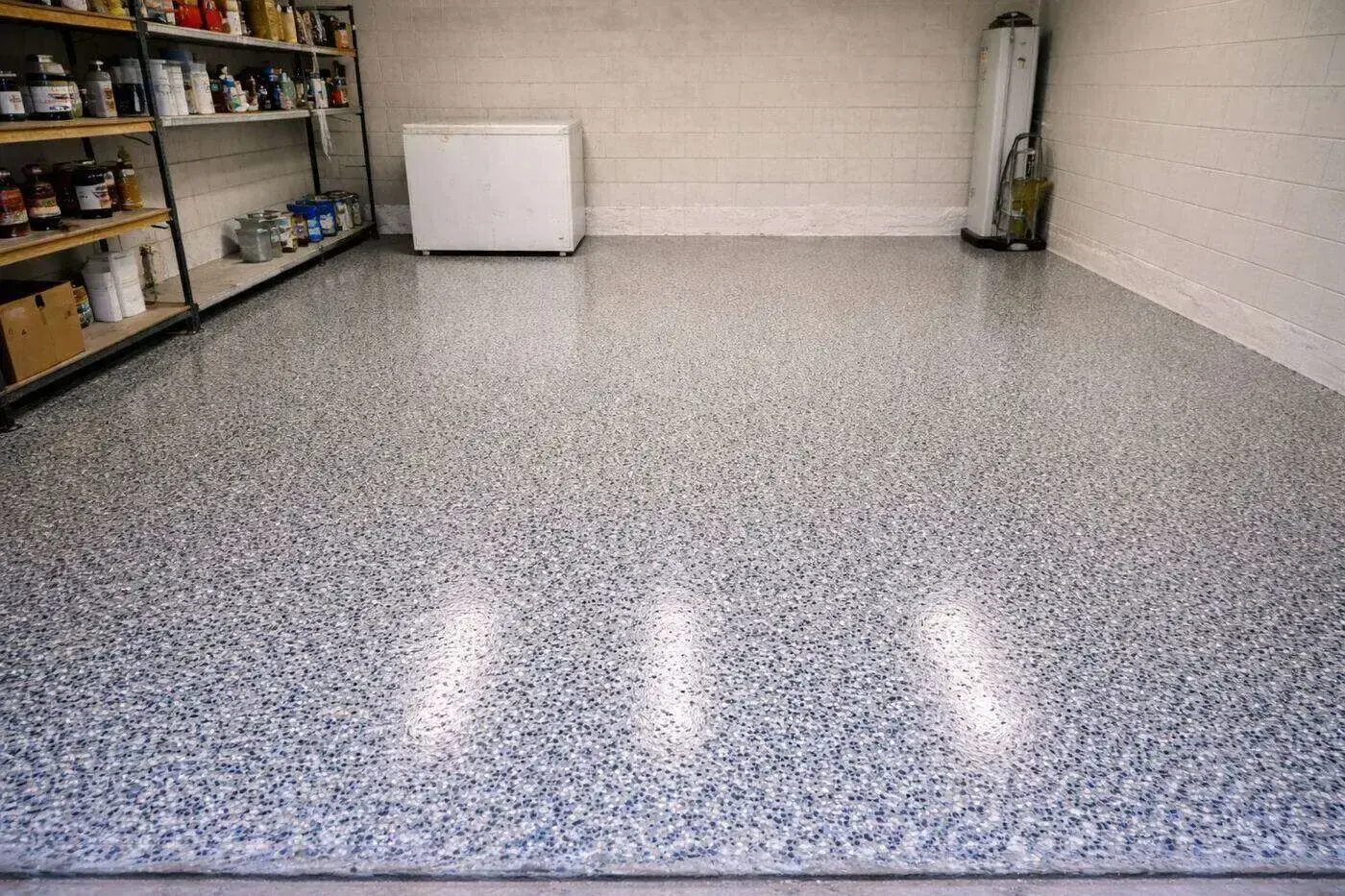
Three primary categories. Solid color epoxy: single pigment, smooth or aggregate-textured, the budget-friendly option. Decorative flake (chip) systems: vinyl chips broadcast into wet epoxy, then sealed with polyaspartic. The most common Orange County install. Metallic epoxy: a clear pigmented topcoat with reflective flakes that flow during cure, producing a 3D look. Premium aesthetic.
A fourth system worth knowing is the quartz broadcast, where colored quartz aggregate is broadcast into the epoxy and sealed under a clear coat. It is the go-to for spaces that need heavy-duty slip resistance and easy cleanup — Orange County restaurant kitchens, healthcare back-of-house, schools, and any floor that has to meet USDA or HACCP standards. Across all four systems, the topcoat is usually the same UV-stable polyaspartic; what changes is the body coat and broadcast underneath it. That is why choosing a "type" is really choosing a look and a texture, not a different durability tier — the protection comes from the top.
Cost ranges in 2026 Orange County
Residential garage: $5–$12 per sq ft installed. 2-car garage (400–600 sq ft): $2,000–$6,000 total. Commercial: $7–$15 per sq ft. Restaurant kitchen with FL DBPR / USDA-compliant integral cove base: $12–$22 per sq ft. Industrial / warehouse: $4–$10 per sq ft for forklift-rated systems. Pool deck: $7–$14 per sq ft including aggregate. We publish these ranges because most competitors don’t — you should be able to budget before you call anyone.
Laid out as a table, the 2026 Orange County ranges look like this:
| Project type | Cost per sq ft | Typical notes |
|---|---|---|
| Residential garage | $5–$12 | 2-car (400–600 sq ft) lands $2,000–$6,000 total |
| Pool deck / lanai | $7–$14 | Includes anti-slip aggregate for wet, sun-exposed use |
| Retail / office | $7–$12 | Economies of scale on larger open floor plans |
| Restaurant kitchen | $12–$22 | DBPR / USDA integral cove base and high-grip surface |
| Industrial / warehouse | $4–$10 | Forklift-rated thicker mil builds; lowest $/sq ft at scale |
What moves you within a range is almost always slab condition and whether moisture mitigation is required — both common in Orange County. The full line-item breakdown, including what concrete repair and a moisture vapor barrier add, is in our dedicated Orlando cost guide.
Installation timeline
Residential garage: one day on site, 5–7 days to full vehicle cure. Commercial: 2–5 days depending on size. Industrial: 3–7 days. Pre-install slab assessment + moisture testing adds 24–72 hours but is non-negotiable in Orange County’s humidity.
A polyaspartic-accelerated system shortens the part that matters most to homeowners — the return to service. Where a traditional all-epoxy build can keep you off the floor for days between coats, polyaspartic cures in hours, so a garage coated in the morning is often walkable that same evening. The 5–7 day window before you park a heavy vehicle is a chemistry-of-full-cure thing, not a "you cannot use the room" thing. The one part of the schedule we never compress is the moisture-test window; rushing that to hit a deadline is the single most common reason a fast install becomes a slow, expensive redo.
Climate considerations specific to Orange County
Three: (1) Humidity — afternoon RH hits 85–95% June–September; only humidity-tolerant systems work in this window. (2) Hurricane-season vapor drive — slabs flooded during Ian or Milton need 60–90 day deferred coating with moisture-tolerant primers. (3) UV under lanais and open garage doors — polyaspartic top coats are essential, not optional, in Florida.
These three are not abstract risks; they are the specific reasons a coating that performs for decades in a dry state can fail in two Orange County summers. The high regional water table keeps vapor pressure pushing up through slabs year-round, the storm season periodically saturates them, and the year-round sun degrades any topcoat that is not UV-stable. An installer who understands Central Florida designs for all three from the first site visit. One who treats your Orlando slab like a slab in a dry climate is setting up the failure you will be paying to fix later.
How to maintain an Orange County epoxy floor
Maintenance is one of epoxy's biggest selling points, and it is genuinely minimal:
- Weekly: dust-mop or soft-broom to clear grit before it gets ground in by tires.
- Monthly: damp-mop with a pH-neutral cleaner — no waxing, sealing, or refinishing ever required.
- As needed: hose-rinse a garage or lanai; rinse pool-chemical and sunscreen splashes rather than letting them dry on the surface.
- After storms: squeegee standing water from low spots and rinse out tracked-in sand, which is the main abrasive in this market.
- Avoid: harsh degreasers and abrasive pads, which dull the polyaspartic over time.
Follow that and the floor stays presentable for its full 15–20+ year life, with an optional single refresh topcoat years down the line if the gloss in a sun-exposed zone ever softens.
Common mistakes that shorten an epoxy floor's life
The flip side of "how to choose well" is knowing the failure patterns. The vast majority of early failures in Orange County come down to a short list of avoidable shortcuts:
- No moisture testing — the number-one cause of peeling on this region's humid, high-water-table slabs.
- Acid-etching instead of diamond-grinding — leaves an inconsistent profile the coating can't reliably grip.
- A standard epoxy topcoat with no polyaspartic — yellows and chalks under Florida UV within a couple of seasons.
- Rushing a pre-storm install in 90°F surface temps and 90%+ humidity, so the coating never cures correctly.
- DIY big-box "epoxy paint" kits over an unprepped slab — the actual source of the "epoxy only lasts a few years" reputation.
How to choose an Orange County installer
Five questions: (1) Will you moisture-test my slab to ASTM F2170 / F1869? (2) Is the top coat polyaspartic or just epoxy? (3) Can I see the written warranty terms before I sign? (4) Are the gallery photos real local installs? (5) What is your quote turnaround and install scheduling timeline? If they hesitate on any of these, get a second quote.
The reason these five questions work as a filter is that each one maps directly to one of the failure modes above. A contractor who moisture-tests, diamond-grinds, specs polyaspartic, shows real Orange County photos, and stands behind a written warranty has, by definition, eliminated the shortcuts that cause early failure. The questions are less about catching a liar and more about confirming the installer's process is built for this climate rather than transplanted from a drier one.
Frequently Asked Questions
What types of epoxy flooring systems are available in Orange County?
The main systems are solid-color epoxy for clean utility spaces, decorative flake for a textured granite-like look that hides imperfections, quartz broadcast for heavy-duty slip resistance in commercial settings, and metallic epoxy for a premium marbled finish. Most systems are finished with a UV-stable polyaspartic topcoat, which is important in Central Florida's sun and heat.
How much does epoxy flooring cost in Orange County in 2026?
Residential epoxy generally runs about $5 to $12 per square foot and commercial projects about $7 to $15 per square foot, depending on the system, slab condition, and whether moisture mitigation is required. A typical two-car garage lands between $2,500 and $5,000 with a quality flake-and-polyaspartic system installed.
How long does an epoxy installation take in Orange County?
A standard garage usually takes one to three days, covering slab grinding, crack repair, the base coat, decorative broadcast, and the topcoat, with cure time between coats. A polyaspartic-accelerated system can shorten the return-to-service window. Larger commercial floors or slabs needing moisture mitigation take longer.
How does Orange County's climate affect epoxy flooring?
Central Florida humidity, heat, intense UV, and frequent summer storms all shape the job. Humid slabs and a high water table mean moisture testing and sometimes a vapor barrier are needed before coating, and a UV-stable polyaspartic topcoat is specified so the finish does not yellow under direct sun. These steps are what separate a lasting floor from one that peels.
How do I choose a good epoxy installer in Orange County?
Choose an installer who moisture-tests every slab, diamond-grinds rather than acid-etches for prep, specifies a UV-stable polyaspartic topcoat, can show local Orange County project photos, and provides a written warranty. Get two or three itemized quotes from in-person inspections and compare the full scope, not just the per-square-foot price.
Is epoxy flooring worth it for an Orange County home?
For most homeowners, yes. A professionally installed system lasts 15 to 20-plus years, wipes clean in minutes, resists stains and hot-tire pickup, and upgrades the look of a garage or living space. The key is correct installation for this climate; done right, it is one of the most durable and low-maintenance floor options available.
Get a free Orlando quote
Quote within 24 business hours. ASTM moisture testing on every slab. Written warranty.
Get a Free Quote Call (407) 783-8654Planning a budget? See our 2026 Orlando epoxy flooring cost guide for line-item pricing by project type.