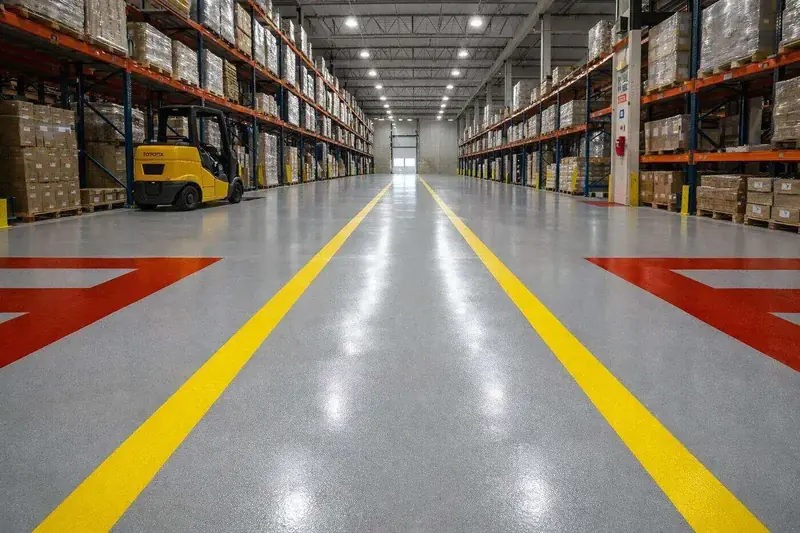
If you’re considering epoxy for an Orlando garage or commercial space, “how long will it last?” is the question that drives the whole decision. The Internet will tell you anywhere from 5 years to “lifetime.” Both extremes are misleading. The realistic answer for a properly installed system in Orlando’s climate is 15–20+ years residential and 5–15 years commercial, depending on traffic, chemicals, and maintenance.
What makes the difference between 5 years and 20+ years is not the brand of epoxy — it’s the prep, the top coat chemistry, and whether the installer respected Florida’s humidity rules. Here’s the breakdown.
Residential lifespan: 15–20+ years
Polyaspartic-topped epoxy on a properly prepped Orlando garage slab routinely lasts 15–20 years. Our oldest local installs are now 6–7 years old and showing zero hot-tire pickup, peeling, or yellowing. The polyaspartic top coat is the durability lever — it’s UV-stable, abrasion-resistant, and chemically inert to most household products including gasoline, brake fluid, and pool chlorine.
The reason residential floors last so long is simple: a home garage in Winter Park or Lake Nona sees a few cars a day, the occasional dropped tool, and seasonal storage rotation — not the continuous abrasion an industrial slab takes. Once the coating is fully cured and the polyaspartic has hardened, the surface is harder than the concrete underneath it. Hot-tire pickup, the failure mode most homeowners worry about, only happens when a thin or improperly cured coating softens under the heat of a tire that has been driven on Central Florida asphalt at 95°F. A correctly built flake-and-polyaspartic system shrugs it off because the cured film does not re-soften.
What you will notice over a 15–20 year span is not failure but gradual gloss change. A high-gloss finish in a south-facing Orlando garage where the door stays open will dull slightly faster than a satin finish in a shaded interior space — but dulling is cosmetic, not structural, and a single refresh coat of polyaspartic restores it without any grinding. That is the difference between a coating that wears and a coating that fails: ours wears slowly and on the surface, where it can be renewed.
Commercial lifespan: 5–15 years
Commercial floors take heavier punishment. Restaurant kitchens with hot oil and constant foot traffic typically get 5–10 years. Auto dealerships and showrooms with rolling stock get 8–12. Light-industrial warehouses get 10–15. The same prep rules apply but commercial systems usually call for thicker mil builds and integral cove bases for FL DBPR compliance.
The variable that moves commercial lifespan the most is point-load and impact, not foot traffic. A restaurant kitchen near International Drive runs the floor hard with grease, hot water, and dropped pans, so it wears chemically and at impact points. A warehouse off the 408 or near the airport logistics corridor sees pallet jacks, forklift tire scrub, and dropped freight — that is mechanical abuse, and it calls for a thicker mil build (often a double-broadcast quartz or a troweled mortar system) rather than a thin decorative coat. We spec the system to the abuse profile of the space, which is why two commercial floors of the same age can be in completely different condition.
What kills lifespan early
Three things shorten epoxy life in Orlando: (1) Skipped moisture testing — the #1 cause of peeling in Florida. Slabs that test above 75% internal RH need moisture-tolerant primers or deferred install. (2) UV exposure with no polyaspartic top coat — epoxy yellows and chalks under direct sun, especially near garage thresholds and lanais. (3) Pre-storm rush installs in August/September — when the contractor pushes through 90°F surface temps and 90% RH to make a deadline, the floor will fail.
All three failure modes are uniquely amplified by Central Florida's climate, which is why a coating that lasts 20 years in Arizona can fail in two summers in Orange County. The high water table across much of Orlando means moisture vapor is constantly being driven up through the slab from below — a phenomenon dry-climate installers rarely have to design around. When that vapor reaches an unprimed or improperly primed coating, it delaminates the bond from underneath. Likewise, the intense UV index that makes Orlando a year-round sun market is the same UV that breaks down the chemical bonds in a standard epoxy topcoat, turning a crisp gray floor amber and chalky within a couple of seasons near an open garage door or lanai.
How to maintain it
Minimal: dust-mop weekly, damp-mop monthly with a pH-neutral cleaner, hose-rinse the garage as needed. After hurricane events, squeegee any standing water from low spots. Avoid harsh degreasers — they dull the polyaspartic over time. With this routine, the floor never needs waxing, sealing, or refinishing.
A few Orlando-specific habits extend the life of the finish further. After a summer storm tracks water and grit into the garage, a quick rinse keeps fine abrasive sand from being ground into the surface by tires. If you park a daily driver on the floor, dropping a breathable mat under the hottest tire-contact zone in the peak of summer is cheap insurance against any gloss change at the contact points. And for pool-adjacent lanai installs, rinsing pool-chemical splashes rather than letting them dry on the surface keeps the polyaspartic looking new — the coating tolerates the chemistry, but standing residue can leave a haze over time.
How an epoxy floor ages, year by year
Durability is easier to understand as a timeline than as a single number. Here is what a correctly installed flake-and-polyaspartic garage floor in the Orlando metro typically looks like at each stage, assuming the maintenance routine above:
| Age | What you’ll see | What it needs |
|---|---|---|
| Years 0–3 | Full gloss, zero wear, color exactly as installed | Routine dust-mop and damp-mop only |
| Years 4–8 | Still no structural wear; possible faint gloss softening in direct-sun zones | Nothing structural; an optional buff if desired |
| Years 9–14 | Minor sheen change at tire-contact and threshold areas; flake body unaffected | Consider a single refresh topcoat to restore gloss |
| Years 15–20+ | Body coat sound and bonded; topcoat has done its job protecting it | Recoat with fresh polyaspartic — no grinding, no rebuild |
Notice that at no point in a properly prepped install does the floor "fail" — it simply reaches the stage where a renewable surface coat has earned its retirement. That is the entire value proposition of a layered system: the expensive, disruptive part (grinding and rebuilding the slab) is done once, and the renewable topcoat carries the floor for decades.
Epoxy vs. other Orlando garage floor options
Lifespan only means something in context. Here is how a professional epoxy system compares against the other surfaces Orlando homeowners weigh against it:
- Bare or sealed concrete: Effectively permanent as a structure, but it stains, dusts, and absorbs oil because it is porous. It is the cheapest option and the hardest to keep looking clean in a humid garage.
- Roll-on garage paint (DIY kits): Often the source of the "epoxy only lasts a few years" myth. Big-box one-part "epoxy paint" applied over an unground, untested slab commonly peels within 1–3 Florida summers. This is a coating problem, not an epoxy problem — it skips every step that makes a professional system last.
- Interlocking PVC tiles: Quick to install and movable, but seams trap water and grit, and in Orlando humidity moisture can collect underneath. Lifespan depends on the tile, but they do not bond to or protect the slab.
- Polyaspartic-topped epoxy (professional install): 15–20+ years residential, renewable with a topcoat, bonded to a diamond-ground and moisture-tested slab. The highest upfront cost of the coatings, and the lowest cost per year of service.
For the line-item numbers behind these systems, see our 2026 Orlando epoxy flooring cost guide — the durability above is what that pricing buys.
Frequently Asked Questions
How long does epoxy flooring last in Orlando?
A properly installed epoxy system on a well-prepped Orlando slab lasts 15 to 20-plus years in residential settings and 5 to 15 years in commercial spaces. The difference between a 5-year floor and a 20-year floor is not the brand of epoxy — it is the slab prep, the topcoat chemistry, and whether the installer respected Central Florida's humidity rules.
What makes epoxy floors fail early in Florida's climate?
Three things shorten epoxy life in Orlando: skipped moisture testing, which is the number-one cause of peeling on humid Florida slabs; UV exposure with no polyaspartic topcoat, which lets the coating yellow and chalk under direct sun; and rushed pre-storm installs in the August-September heat and humidity, where the coating never cures correctly.
Why does a polyaspartic topcoat extend lifespan in Orlando?
The polyaspartic topcoat is the durability lever. It is UV-stable so it will not yellow under Central Florida's intense sun, it is abrasion-resistant against hot-tire pickup, and it is chemically inert to most household products including gasoline, brake fluid, and pool chlorine. That is why we specify it on every garage and exterior-adjacent install in the Orlando metro.
How do I maintain an epoxy floor so it lasts 20 years?
Maintenance is minimal: dust-mop weekly, damp-mop monthly with a pH-neutral cleaner, and hose-rinse the garage as needed. After hurricane events, squeegee any standing water from low spots. Avoid harsh degreasers, which dull the polyaspartic over time. With this routine the floor never needs waxing, sealing, or refinishing.
Does commercial epoxy last as long as residential in Orlando?
Commercial floors take heavier punishment, so they run shorter: restaurant kitchens typically get 5 to 10 years, auto dealerships and showrooms 8 to 12, and light-industrial warehouses 10 to 15. The same Florida prep rules apply, but commercial systems usually call for thicker mil builds and integral cove bases for state health-code compliance.
Can a failing or older epoxy floor be recoated instead of replaced?
Often, yes. If the existing coating is still bonded and the slab is sound, a worn floor can be cleaned, lightly abraded, and recoated with a fresh polyaspartic topcoat rather than fully removed and rebuilt. If the floor is peeling because moisture was never addressed, the slab has to be ground back and re-prepped first. A free Orlando assessment determines which path applies.
Get a free Orlando quote
Quote within 24 business hours. ASTM moisture testing on every slab. Written warranty.
Get a Free Quote Call (407) 783-8654Planning a budget? See our 2026 Orlando epoxy flooring cost guide for line-item pricing by project type.