The number-one reason epoxy floors fail in Orlando is moisture vapor rising through humid Central Florida slabs, combined with rushed or skipped surface prep. Get those two things right — a real moisture test and proper diamond-grinding — and an epoxy floor lasts 15 to 20-plus years here. Get them wrong and it bubbles, peels, or delaminates within months, no matter how good the coating is.
This is the failure pattern we are called to fix most often in the Orlando market, and it is almost always preventable. Below we explain exactly why local floors fail, the mechanism behind moisture-driven failure, the testing and prep steps that stop it, the other (less common) causes worth knowing, and the specific questions that separate a contractor whose floors last from one whose floors peel. If you have a floor that is already failing, call (407) 783-8654 for an honest assessment.
The #1 Cause of Failure
If you remember one thing from this article, make it this: in Orlando, the leading cause of epoxy failure is moisture — specifically, water vapor moving up through the concrete slab from the ground below. Florida's average relative humidity sits around 74 percent, and much of Orange and Seminole County sits over a high water table. That combination drives a steady stream of moisture vapor up through slabs that contractors in dry climates rarely have to think about.
The second half of the problem is preparation. Even on a dry slab, epoxy will not last if the concrete was not opened up properly so the coating can grip. When an installer cuts the prep short to finish faster, the bond is weak from day one. Moisture and under-prep frequently appear together, because the same crew that skips the moisture test also tends to skip the grinding — and the result is a floor that looks great for a season and then lets go.
How Moisture Failure Happens
Understanding the mechanism makes it obvious why the prevention steps are non-negotiable.
Vapor pressure under the coating
Concrete is porous. Ground moisture wicks up into the slab and evaporates at the surface as vapor. When you seal that surface with an epoxy coating and there is no vapor barrier, the vapor has nowhere to go. It builds pressure underneath the coating until it overcomes the bond and pushes the epoxy up — you see it as blisters, bubbles, or sheets of coating lifting away from the slab. This is osmotic blistering and delamination, and it is the classic Florida failure.
Why it is invisible at install time
The cruel part is that the slab can look bone-dry on installation day. Moisture vapor transmission is not about visible water; it is about the rate of vapor moving through the slab, which you cannot see or feel. That is why a floor can be coated on a sunny afternoon, look perfect for weeks, and then start bubbling once the vapor builds up. The only way to know the rate is to test it.
Hurricane-impacted slabs
Slabs in homes affected by Hurricane Ian or Milton can hold elevated moisture and residual contamination for a long time. These slabs need extended drying and careful testing before coating, and treating them like any other slab is a recipe for failure. An experienced Orlando installer factors this in.
The Test & Prep That Prevent It
Two steps prevent the overwhelming majority of Orlando floor failures. Neither is optional on a slab in this climate.
| Step | What it does | Why it matters in Orlando |
|---|---|---|
| Moisture testing | Calcium chloride or RH probe measures vapor rate | Catches the #1 failure cause before coating |
| Vapor barrier (if needed) | Seals the slab against vapor pressure | Required when readings exceed safe limits |
| Diamond grinding | Profiles the concrete for a mechanical bond | Ensures the coating actually grips the slab |
| UV-stable topcoat | Resists sun yellowing and abrasion | Protects against Central Florida sun and heat |
Design your floor and see your Orlando price range in 60 seconds.
Open Floor Studio →Moisture testing, step by step
Before any grinding, a calcium chloride test or a relative humidity probe is placed on the slab to measure how much vapor is moving through it. If the result is within safe limits, the install proceeds. If it is high, the slab gets a moisture vapor barrier — a specialized primer or membrane that seals the vapor out — before the epoxy goes down. Roughly one in three residential projects and more than half of commercial projects in Orlando need some form of moisture mitigation.
Mechanical prep, done right
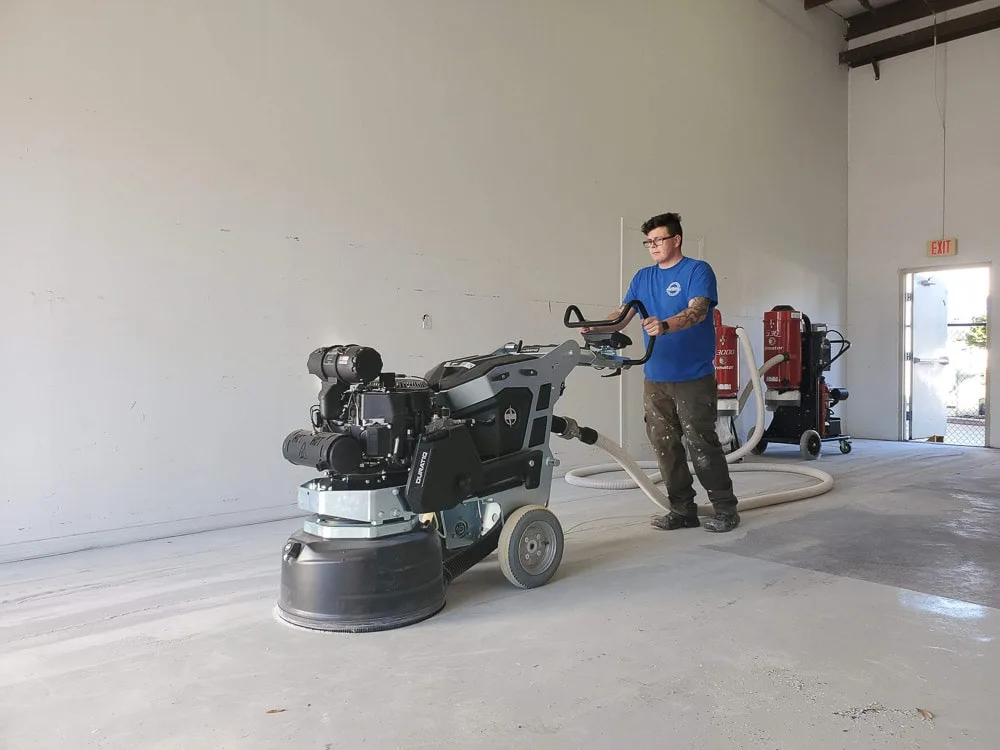
Diamond-grinding (or shot-blasting on larger floors) opens the concrete surface to a proper profile so the coating bonds mechanically, not just chemically. This is the step bargain installers cut. A lightly acid-etched or unground slab leaves the epoxy clinging to a smooth, weak surface that peels under hot tires and traffic. Proper grinding is the difference between a floor that holds and one that flakes.
Other Causes of Failure
Moisture and prep cause most Orlando failures, but a few others are worth knowing:
- No UV-stable topcoat: plain epoxy yellows and chalks under Central Florida sun near garage doors and lanais. The fix is a polyaspartic topcoat.
- Rushed pre-storm installs: coating a slab in 90-degree heat and 90 percent humidity to beat a deadline produces a poor cure and early failure.
- Thin single-coat "deals": one diluted coat with no real system underneath wears through fast.
- Contaminated slab: oil, sealers, or old coatings not removed before installation prevent a proper bond.
- Hot-tire pickup on weak coatings: a soft or under-cured surface lets warm tires lift the coating.
Floor already bubbling or peeling?
We will diagnose whether it is moisture, prep, or something else — and tell you exactly what it takes to fix it for good.
What to Ask a Contractor
The easiest way to avoid a failed floor is to hire the right installer. Ask these questions and listen for confident, specific answers:
- Do you moisture-test every slab, and how? The answer should be yes, by calcium chloride or RH probe, every time.
- Do you diamond-grind or shot-blast for prep? You want mechanical prep, not a quick acid etch.
- Do you install a vapor barrier when readings are high? They should be able to explain when and why.
- Do you finish with a UV-stable polyaspartic topcoat? Essential for Orlando sun exposure.
- Can you show local Orlando project photos and a written warranty? Proof of work in this climate, in writing.
For more on the climate side of this, see our guide on how Orlando humidity affects your epoxy floor.
Frequently Asked Questions
Why do epoxy floors fail in Orlando?
The number-one cause of epoxy failure in Orlando is moisture vapor pushing up through humid Central Florida slabs, combined with inadequate surface prep. When a slab is not moisture-tested and the concrete is not properly ground, the coating cannot bond or breathe, so it bubbles, peels, or delaminates — often within months. Both problems are preventable with the right process.
What is moisture vapor transmission and why does it matter here?
Moisture vapor transmission is water vapor moving up through a concrete slab from the ground below. Orlando's high water table and year-round humidity make it common. When that vapor reaches an epoxy coating with no vapor barrier, the pressure underneath lifts the coating off the slab. It is the single most common reason Florida floors fail, and it is invisible until the floor starts bubbling.
How do you test for moisture before installing epoxy?
A professional installer runs a calcium chloride test or a relative humidity probe test on the slab before any coating goes down. These measure how much moisture is moving through the concrete. If the readings exceed safe thresholds, a moisture vapor barrier is installed first. Skipping this test to save time is the most common shortcut behind premature failure in Orlando.
Does poor surface prep cause epoxy to peel?
Yes. Epoxy needs a clean, properly profiled surface to bond. Diamond-grinding or shot-blasting opens the concrete so the coating can grip. When an installer acid-etches lightly or skips grinding to save time, the bond is weak and the floor peels under traffic and heat. Proper mechanical prep is non-negotiable for a lasting Orlando floor.
What should I ask a contractor to avoid a failed floor?
Ask whether they moisture-test every slab and how, whether they diamond-grind or shot-blast for prep, whether they install a vapor barrier when readings are high, and whether they finish with a UV-stable polyaspartic topcoat. Ask for local Orlando project photos and a written warranty. A contractor who tests and grinds every slab is the one whose floors last.
Can a failed epoxy floor be fixed?
Yes, but it usually means starting the prep over. A peeling or bubbling floor has to be ground back to sound concrete, the moisture issue addressed with testing and a vapor barrier if needed, and a new system installed correctly. Patching over a moisture failure rarely holds. A free assessment determines how much of the floor needs to be redone.
Get a Floor That Won't Fail
Epoxy failure in Orlando is not bad luck — it is the predictable result of skipping the moisture test and the grinding. Do both correctly, finish with a UV-stable topcoat, and the floor lasts for decades. Cut those corners and it fails fast.
Whether you are planning a new floor or fixing one that failed, call us at (407) 783-8654 or request a free quote online. We serve Orlando, Kissimmee, Winter Park, Sanford, Apopka, Altamonte Springs, and the surrounding communities throughout Central Florida.